Is Shalem an AI rabbi? What it is, what it won't do, and why it shows sources
No. Shalem is a Jewish wisdom chat. You can ask it anything, or share what's on your mind, and it answers from Jewish sources, with the source shown. A rabbi knows you, your community and your circumstances, and can rule on your case. Shalem doesn't pretend to do that.
Why this matters now
There's been recent reporting on fake AI "rabbis": chatbots that speak with invented authority and sometimes invent the sources too. Searching for an "AI rabbi" is often a search for trust: can I rely on this answer? We built Shalem around that question.
What Shalem does
- Answers from a real library: 50,242 passages from 51 classic works. They include the whole Hebrew Bible (all 24 books, with all 150 Tehillim), Pirkei Avot, the Talmud's wisdom and teachings (Ein Yaakov), the Midrash Pirkei DeRabbi Eliezer, the great Musar works (Mesillat Yesharim, Orchot Tzadikim and Sha'arei Teshuvah), the whole Mishnah, and the codes of Jewish law (Mishneh Torah, Shulchan Arukh with Mishnah Berurah, Kitzur Shulchan Arukh, Sefer HaChinukh and Chafetz Chaim). There are also 1,278 bits of Torah wisdom retold for Shalem.
- Shows the source: the reference, the text in Hebrew and English, and the translation with its licence, for example "Tehillim 139:14 · JPS 1917 · Public Domain".
- Never invents a quote: a separate check reads every answer against the passages it used. If a line isn't supported, it's removed or the answer is rewritten. If nothing in the library fits, Shalem doesn't make up a source: it answers in its own words and labels it "Shalem's reflection".
- Meets you where you are: a bit of Torah wisdom for what you're going through, a few small practices, and, if you want, a 7-day Path toward a goal.
What Shalem won't do
- Rule on your case. For a question of Jewish law, Shalem gives the source and explains plainly what it says. It notes that circumstances change how the law applies, and sends you to a qualified rabbi for your own situation.
- Replace a person. For grief, illness or anything heavy, it will gently point you to the people and services who can help, and to emergency help when safety is at risk.
- Speak for one denomination. Shalem is for any background and any level of knowledge. Where the sources differ, it says so.
An example
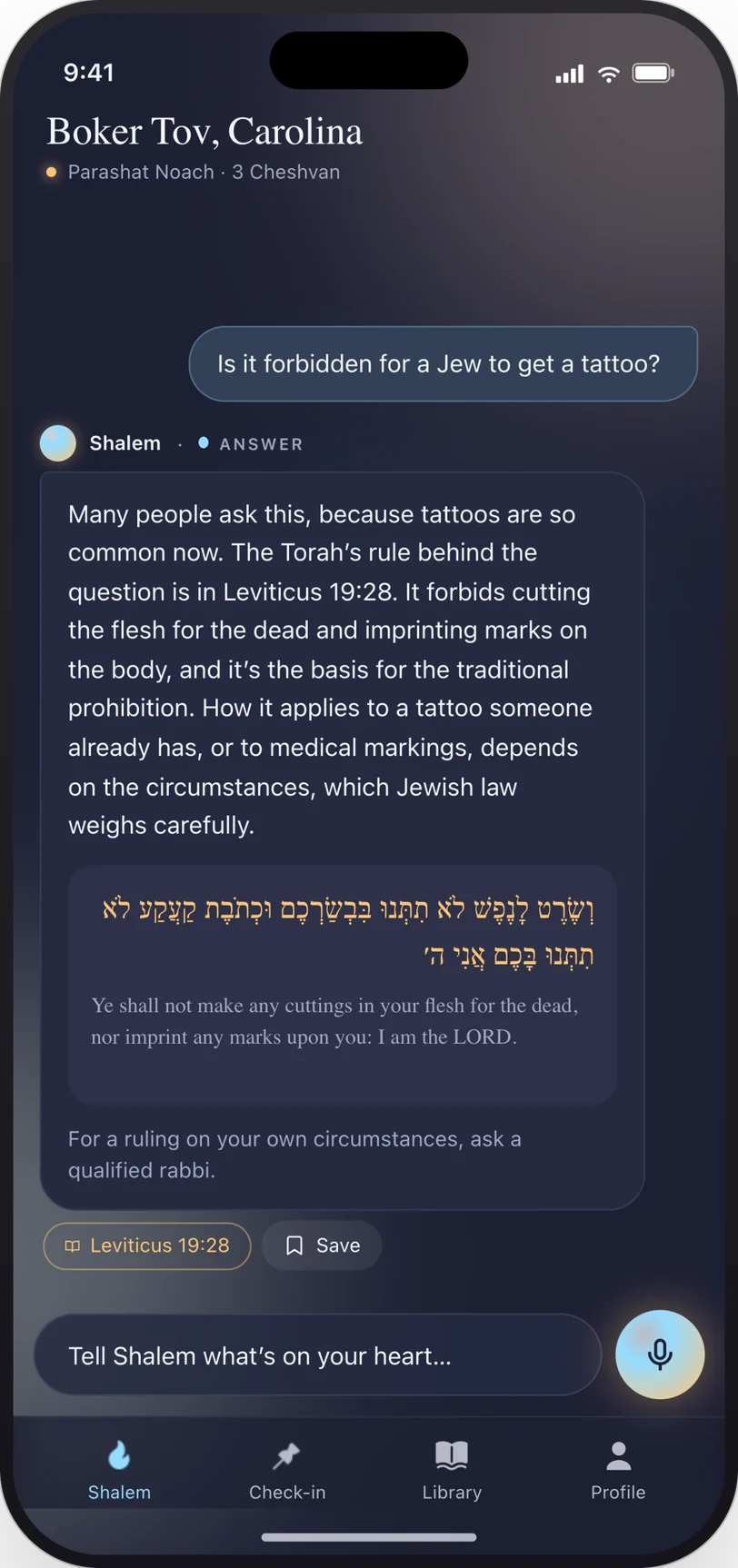
Ask "Is it forbidden for a Jew to get a tattoo?" and Shalem quotes the verse behind the traditional prohibition:
"Ye shall not make any cuttings in your flesh for the dead, nor imprint any marks upon you: I am the LORD." (Leviticus 19:28, JPS 1917)
It explains that this is the basis for the prohibition, that cases like an existing tattoo or medical markings depend on circumstances, and that a rabbi should rule on your own case.
Shalem, Sefaria and Ask the Rabbi
They do different jobs, and many people use all three:
- Sefaria is a vast library to search and study.
- "Ask the Rabbi" services, from Chabad, Aish and others, give a human answer from a rabbi.
- Shalem is a warm conversation, any time, by voice or text, that answers from the sources and shows them.
Your privacy
What you share is private. On the phone, your conversations, Reflections and Paths are encrypted before they're stored, and our servers keep only encrypted copies. Your messages are sent securely to our AI providers only to write the answer. See our privacy policy for who they are and what each one keeps.
Questions people ask
Is Shalem an AI rabbi?
No. Shalem is a Jewish wisdom chat that answers from classic Jewish sources and shows them. It doesn't give rulings. For questions of Jewish law about your own situation, it sends you to a qualified rabbi.
Where do Shalem's answers come from?
From 50,242 passages in 51 classic works: the Hebrew Bible, Pirkei Avot, the Talmud's wisdom (Ein Yaakov), Midrash, Musar, the Mishnah and the codes of Jewish law. Also from 1,278 bits of Torah wisdom retold for Shalem. Most answers come from these sources and show them. When no text fits, Shalem answers in its own words, marked "Shalem's reflection".
Does Shalem make up quotes?
It's built not to. A separate check compares each answer with the passages it used and removes anything they don't support. If no source fits, Shalem never invents one: it answers in its own words and labels it "Shalem's reflection", so you can tell it apart from a sourced answer.
Can Shalem answer questions about Jewish law?
It explains what the sources say and notes where views differ. It doesn't rule on your case. For that, ask your rabbi.
Is Shalem for any denomination?
Yes. It's for any background and any level of knowledge, and it doesn't speak for one movement.